
Inside the Factory: China, 2011
- Alan Young

- Dec 12, 2025
- 4 min read
Updated: Dec 29, 2025

exif: 1/60 sec · f/4.0 · ISO 2000
There are photographs you admire, photographs you are proud of, and then there are photographs that stay with you.
These two images fall firmly into the last category.
They were taken in 2011 inside a factory in China while I was auditing suppliers. Photography was not the purpose of the visit, and these were never planned images. I had a Canon EOS 5D mkII with me, paired with a 17–40mm lens, handheld, using only the available light. No flash. No staging. No second chances.
At the time, I did not fully understand what I had captured. Only with distance did these photographs begin to reveal their weight and relevance, not as records of a specific place, but as observations of work, hierarchy, and quiet human presence. They sit outside intention and expectation, shaped by instinct rather than design, and that is precisely why they have endured. Looking back now, they remain two of the most honest photojournalistic images I have ever taken.
Photographing Without Permission, Without Performance
Factories are not designed to be photographed. They are functional, repetitive, noisy environments where time is measured in output rather than moments. The light is harsh and inconsistent, often fluorescent, often failing. The spaces are cramped and visually cluttered. None of this is conducive to comfortable image-making.
And yet, that is precisely why the camera becomes important.
In the first image, a line of workers sit absorbed in their tasks, their backs turned, bodies angled forward in concentration. The machines dominate the foreground. The ceiling presses down. Overhead strip lights carve hard lines through the frame. To the right, a man stands apart, observing quietly, hands behind his back. He is not part of the production line, yet he is not separate from it either. His presence introduces tension and hierarchy without a single word being spoken.
exif: 1/60 sec · f/4.0 · ISO 2000
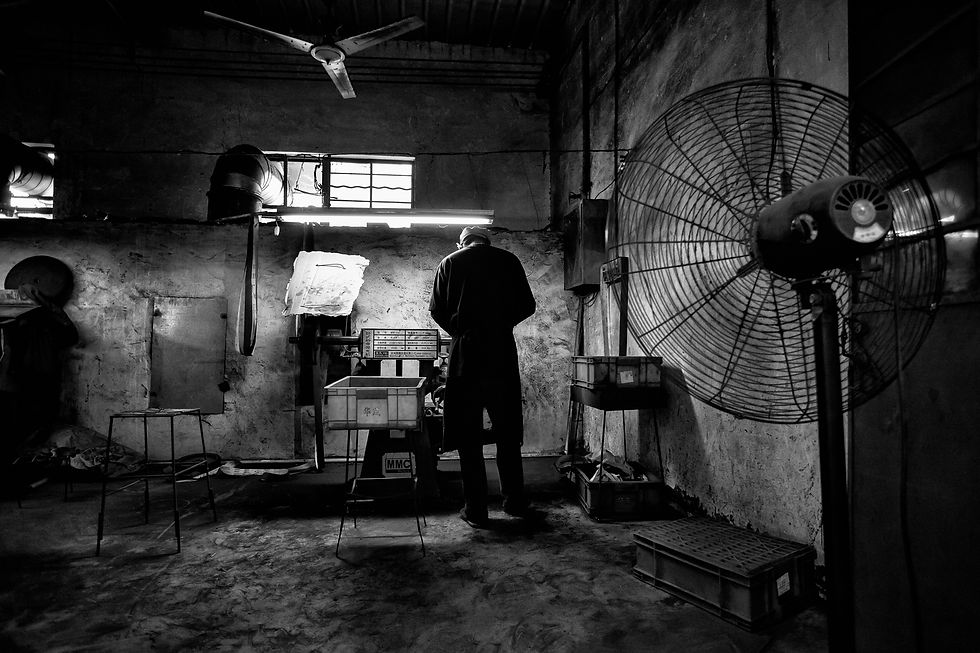
The photograph does not explain itself. It does not need to. The second image is quieter, almost meditative. A solitary figure stands with his back to the camera, framed against a rough wall and a single window. The fan to the right looms large, static yet symbolic of movement, heat, and air that never quite circulates. The room feels heavy. Time feels suspended.
This is not a decisive moment in the traditional sense. It is something slower and more observational. A moment that exists whether the camera is there or not.
Why Black and White Was the Only Choice
These images were always going to be black and white.
Colour would have distracted from what matters here: gesture, posture, light, and space. By removing colour, the photographs become about labour, repetition, and environment. The tonal contrast emphasises texture: cracked walls, worn floors, metal machines, fabric clothing softened by use.
Black and white also removes any sense of exoticism. This is not about “China” as a location. It is about work. About people. About systems. About the quiet dignity and weight of routine.
Working Fast, Trusting Instinct
Technically, these images are straightforward.
Canon EOS 5D mkII. 17–40mm lens.
Handheld.
No flash.
What mattered was speed and instinct. There was no time to refine compositions or wait for ideal expressions. The camera came up, the frame was set, and the shutter was released. Years of shooting had already trained my eye. The discipline of film photography, of learning to see before pressing the shutter, mattered more here than any technical setting.
This is the kind of photography where hesitation costs you the image.
Why These Images Still Matter
Over the years, my photography has evolved. The cameras have changed. The workflows have become more refined. The prints more controlled. But these photographs remain important to me because they remind me why I picked up a camera in the first place.
They are honest. They are unpolished. They do not ask for attention, yet they hold it.
They document a reality that is rarely seen by the people who ultimately depend on it. There is no commentary imposed, no narrative forced. The images simply exist and invite the viewer to look longer. That, to me, is the essence of photojournalism.
Even now, more than a decade later, these two frames still feel alive. And that is perhaps the highest compliment I can give any photograph.
Looking back, these photographs represent a period of my photography where instinct mattered more than intention. There was no brief, no expectation of an outcome, only the act of observing and responding to what was in front of me. That approach continues to inform how I work today, whether I am photographing people, places, or quieter moments that sit between the obvious ones. The tools have changed, and the process has evolved, but the importance of attention, restraint, and respect for the subject remains the same.
If you would like to explore more of my documentary and observational work, including people and street photography captured in similar environments, visit my Street Photography portfolio. It offers a broader view of images shaped by instinct, available light, and moments observed rather than constructed.
You can comment as a guest — no account required.

Comments