
The Common Kestrel
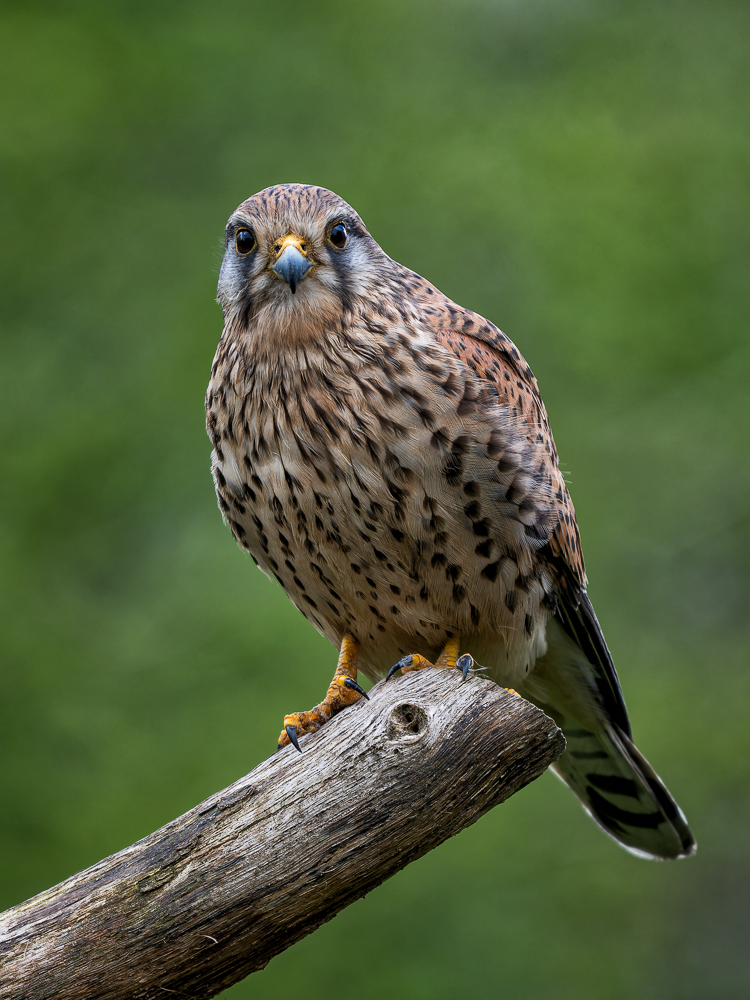
The Hovering Hunter of Britain's Open Countryside
Long before it is identified, the bird announces itself through behaviour.
Suspended against the wind, wings beating rapidly, tail fanned wide, it appears almost motionless above a field. For a moment it seems to defy gravity itself, hanging in the air while scanning the ground below.
Then it drops.
The descent is sudden and purposeful. Wings fold, feet extend and the bird disappears into the grass.
For generations, scenes like this have played out above Britain's farmland, meadows and roadside verges. The Common Kestrel has become one of the country's most familiar birds of prey, recognised as much for its remarkable hovering ability as for its striking appearance.
Yet familiarity can sometimes conceal significance.
Many people see Kestrels regularly without appreciating the extraordinary adaptations that allow them to hunt so effectively. Others remember a time when the species seemed far more common than it does today, when almost every journey through the countryside offered the chance of spotting a bird hovering above a field.
The Kestrel occupies a unique place in Britain's natural history.
Unlike woodland hawks that rely upon surprise and concealment, or falcons that pursue prey through high-speed aerial chases, the Kestrel is a patient hunter. It relies upon observation, precision and an intimate understanding of the landscape below.
Its world is one of open spaces.
Pastures, rough grassland, heathland, coastal cliffs and agricultural fields all provide opportunities to hunt. From fence posts and telegraph poles to isolated trees and roadside markers, the Kestrel constantly searches for the movement of small mammals hidden beneath the vegetation.
What appears to be an ordinary field can, through the eyes of a Kestrel, become a map of opportunity.
Every patch of rough grass may conceal a vole.
Every hedgerow may support prey.
Every gust of wind can either aid or hinder the hunt.
As a wildlife photographer, the Kestrel remains one of the most captivating birds to observe. Its behaviour is often visible, its hunting techniques fascinating and its relationship with the landscape impossible to ignore.
Unlike the brief flash of a Kingfisher disappearing along a river, the Kestrel frequently allows us to witness the entire sequence. We see the hover, the concentration, the decision and the strike.
The bird becomes both hunter and storyteller.
To understand the Kestrel is to understand something fundamental about Britain's countryside. It is a species shaped by weather, agriculture, prey abundance and habitat quality. Its fortunes rise and fall alongside the health of the landscapes it inhabits.
The sight of a hovering Kestrel remains one of the defining images of rural Britain.
It is a moment of stillness within movement, a reminder that survival often depends not on speed or strength alone, but on patience, observation and perfect timing.
For those willing to look closely, the Kestrel offers far more than a fleeting encounter.
It offers a window into the hidden lives of the open countryside itself.
Identification and Anatomy
Few birds of prey are as instantly recognisable as the Common Kestrel.
Even at considerable distance, its shape and behaviour often provide clues to its identity. Long, pointed wings, a relatively slender body and the distinctive habit of hovering above open ground combine to create one of the most familiar silhouettes in the British countryside.
Yet the Kestrel's appearance tells only part of the story.
Every aspect of its anatomy has evolved to support a lifestyle centred on hunting small mammals across open landscapes. From its exceptional eyesight to its finely tuned flight characteristics, the species is perfectly adapted for detecting and capturing prey hidden beneath grass and vegetation.
Measuring between 32 and 39 centimetres in length, with a wingspan approaching 80 centimetres, the Common Kestrel is smaller than many people expect. It lacks the bulk of larger raptors such as the Buzzard, instead appearing elegant and agile both in flight and at rest.
This lighter build contributes significantly to its hunting strategy.
The most striking feature is often the head.
Adult males possess a distinctive blue-grey crown and tail, contrasting with warm chestnut upper parts marked with black spots. Females and juveniles are generally browner overall, with heavier barring across the tail and upper body.
These differences make the Kestrel one of the easier birds of prey to sex in the field.
A perched male often appears almost refined in appearance, the cool tones of the head contrasting beautifully against the richer colours of the body. Females, while less colourful, possess a subtle beauty of their own and are often noticeably larger than males.
The eyes are perhaps the most remarkable feature.
Like all birds of prey, Kestrels rely heavily on vision. Their eyesight far exceeds our own, allowing them to detect the slightest movement from considerable distances. A hunting bird can spot a vole moving through vegetation that appears completely motionless to a human observer.
Research has also shown that Kestrels can detect ultraviolet light.
This ability may help them identify the scent trails left by small mammals, effectively allowing them to locate areas where prey activity is highest before committing to a hunt.
The bill is relatively small compared with some raptors, reflecting the size of the prey typically taken.
Sharp and hooked, it is used to dispatch and consume prey after capture. The real hunting tools, however, are the feet.
Equipped with powerful talons, the Kestrel can seize prey with remarkable speed and precision. A successful strike often lasts only a moment before the bird rises again carrying its catch.
Perhaps the most distinctive adaptation is found in the wings.
Long and relatively narrow, they provide the lift and manoeuvrability required for the species' famous hovering behaviour. By making constant adjustments to wing position and tail angle, a Kestrel can remain almost stationary in strong winds while maintaining a fixed gaze on the ground below.
To watch this behaviour closely is to appreciate the extraordinary control involved.
The bird is never truly still.
Every feather, every wingbeat and every subtle movement contributes to maintaining position. What appears effortless is in reality a continuous process of adjustment and balance.
Together, these adaptations create one of Britain's most specialised hunters.
The Kestrel may lack the raw power of larger raptors or the breathtaking speed of a Peregrine, but it possesses something equally impressive: the ability to turn patience into a hunting strategy.
Its anatomy reflects this perfectly.
Every feature serves a purpose.
Every adaptation contributes to survival.
And every hovering bird above a field is a reminder that some of nature's most remarkable hunters succeed not through strength alone, but through precision, observation and timing.
Habitat and Distribution
The Kestrel is often described as a bird of open country.
While this is true, the phrase barely captures the remarkable variety of landscapes in which the species can be found. From lowland farmland and rough grassland to coastal cliffs, heathland and upland moor edges, the Common Kestrel has adapted to a diverse range of habitats across Britain.
What matters most is not the landscape itself.
It is the availability of prey.
Where small mammals are abundant, Kestrels are rarely far away.
Across much of the country, the species remains a familiar sight. It occurs throughout England, Wales, Scotland and Northern Ireland, occupying habitats that provide suitable hunting opportunities and nesting locations.
Unlike some birds of prey that depend upon extensive woodland or remote wilderness, the Kestrel often lives alongside people.
It is equally at home hunting beside a country lane as it is over a remote moorland valley.
For generations, telegraph poles, fence posts and isolated trees have served as lookout points from which Kestrels scan the ground below. These elevated perches allow the bird to conserve energy while maintaining an excellent view of potential prey.
A roadside Kestrel perched against the sky has become one of the defining images of rural Britain.
A Landscape Built on Voles
Although Kestrels take a variety of prey, small mammals remain the foundation of their success.
Field voles, bank voles and mice provide the bulk of the diet across many areas. Insects, small birds and reptiles may supplement this food source, particularly during warmer months, but healthy populations of small mammals are often the key to productive Kestrel habitat.
This dependence creates a close relationship between the bird and the structure of the landscape.
Rough grassland is particularly important.
Areas left unmanaged for extended periods often support greater numbers of voles and other small mammals than intensively managed farmland. Field margins, hedgerows and uncultivated corners of agricultural land can therefore provide valuable hunting opportunities.
To the casual observer, these areas may appear untidy.
To a Kestrel, they represent potential feeding grounds.
The Role of Farmland
Much of Britain's Kestrel population occupies agricultural landscapes.
Historically, traditional farming practices often created a patchwork of habitats that supported abundant prey. Hay meadows, rough pasture, hedgerows and field margins all contributed to a rich ecological network.
Modern agriculture has altered some of these relationships.
Increased field sizes, changes in land management and reductions in rough grassland have affected prey populations in certain areas. As a result, Kestrel numbers have declined in parts of Britain where suitable hunting habitat has become less abundant.
The bird remains widespread, but its fortunes are closely linked to the health of the countryside.
The Kestrel's story is therefore also a story about land use and habitat quality.
Coastal and Upland Landscapes
Although often associated with farmland, Kestrels are equally capable of exploiting other environments.
Along Britain's coastline they may be seen hunting above dunes, cliff tops and coastal grassland. In upland regions they patrol moorland edges, rough grazing land and sheltered valleys where prey remains plentiful.
These landscapes present different challenges.
Stronger winds, harsher weather and seasonal fluctuations in prey abundance all influence behaviour. Yet the species' adaptability allows it to thrive in locations where many other predators struggle.
The familiar hover remains the constant.
Whether above a Yorkshire pasture, a Welsh hillside or a Scottish coastline, the technique remains one of the most effective hunting strategies in the avian world.
Nesting Opportunities
Suitable nesting sites are another important component of Kestrel habitat.
Unlike many birds, Kestrels rarely build elaborate nests of their own. Instead, they frequently occupy existing sites, including old crow nests, tree cavities, cliff ledges and purpose-built nest boxes.
This flexibility has contributed significantly to the species' success.
A suitable hunting territory combined with a safe nesting location often provides everything required to support a breeding pair.
In recent years, nest box schemes have helped support local populations in some areas, offering additional nesting opportunities where natural sites are limited.
Reading the Landscape
One of the pleasures of watching Kestrels is learning to recognise habitat through their eyes.
A seemingly ordinary field becomes more interesting when viewed as a hunting ground.
A rough grass margin becomes a source of prey.
A telegraph pole becomes a lookout post.
The landscape begins to reveal hidden layers of ecological activity.
For wildlife photographers, this understanding can be invaluable.
Rather than searching randomly for birds, it becomes possible to identify locations where Kestrels are likely to hunt, perch and patrol. The habitat itself begins to provide clues.
In many ways, successful wildlife photography starts long before the bird appears.
It starts with learning to read the landscape.
And few species teach that lesson more effectively than the Common Kestrel.
The Art of Hovering
If the Kingfisher is defined by the dive, the Kestrel is defined by the hover.
Few sights in British wildlife are as instantly recognisable.
A bird hangs motionless above a field, wings beating rapidly against the wind, head fixed on a point below. For several seconds, sometimes much longer, it appears suspended in space.
Then, without warning, it drops.
The descent is sudden, direct and purposeful.
For generations this behaviour has fascinated birdwatchers, photographers and naturalists alike. It seems to challenge the normal rules of flight, giving the impression that the bird has somehow learned to pause in mid-air.
The reality is even more impressive.
Defying Gravity
A hovering Kestrel is never truly still.
Every second requires hundreds of tiny adjustments. The wings beat continuously, the tail fans and twists, and the body shifts subtly to compensate for changing wind conditions.
The bird is engaged in a constant balancing act.
What appears effortless from a distance is, in reality, an extraordinary demonstration of aerial control.
Wind plays a crucial role.
Kestrels frequently position themselves facing directly into the breeze, allowing air to flow over the wings and generate lift. Strong headwinds can make hovering more efficient, enabling the bird to maintain position while expending less energy than would otherwise be required.
On calm days, hovering becomes far more demanding.
The bird must rely almost entirely on wing power to remain stationary.
Watching a Kestrel hover in changing conditions quickly reveals the remarkable adaptability of the species.
Eyes Fixed on the Ground
The purpose of hovering is simple.
To find food.
While the wings work constantly to maintain position, the head remains astonishingly stable. Even in strong winds, the bird's gaze remains fixed upon the ground below.
This stability is essential.
The slightest movement within the grass may indicate the presence of a vole, mouse or other prey species. Detecting that movement requires concentration and extraordinary visual precision.
A hunting Kestrel is not simply looking at the landscape.
It is searching for tiny signs of life hidden within it.
From high above a field, the bird can detect movement that would remain invisible to most human observers.
Every hover is an act of observation.
The Moment of Decision
Most hovers do not end in a strike.
The bird may remain suspended for several seconds before drifting elsewhere and beginning again. Sometimes prey disappears beneath thicker vegetation.
Sometimes conditions are unsuitable. Sometimes the Kestrel simply decides the opportunity is not worth pursuing.
Patience is part of the strategy.
Then comes the moment of commitment.
The wings fold partially, the body tilts forward and the bird drops towards the ground. Speed increases rapidly as the distance closes.
For a brief moment, predator and prey are locked into a contest measured in fractions of a second.
Success is never guaranteed.
Voles escape.
Attacks miss their target.
The grass conceals movement.
The Kestrel simply rises and begins the process again.
Precision Over Power
Unlike larger birds of prey that often rely upon strength and surprise, the Kestrel depends heavily upon accuracy.
Its hunting technique is built around efficiency.
Rather than covering vast distances in search of food, it focuses attention on specific areas where prey activity appears greatest. The hover allows the bird to inspect potential hunting grounds with exceptional detail before committing valuable energy to an attack.
This strategy has served the species remarkably well.
Across Britain and much of Europe, the Kestrel has become one of the most successful and widespread small falcons, perfectly adapted to landscapes where prey may be abundant but difficult to locate.
A Photographer's Perspective
For wildlife photographers, hovering behaviour presents a unique opportunity.
Unlike many hunting sequences that unfold too quickly to anticipate, a hovering Kestrel provides time.
Time to compose.
Time to focus.
Time to appreciate the extraordinary control on display.
Yet photographing the behaviour successfully remains challenging.
Wing positions change constantly. Wind conditions influence movement.
Backgrounds can quickly become distracting. Capturing both sharpness and a sense of motion requires careful timing and no small amount of patience.
The most successful images often reveal more than the bird itself.
They tell the story of the hunt.
A hovering Kestrel photographed against an open landscape immediately communicates purpose. The viewer understands that something important is happening, even if the prey remains unseen.
The Signature of the Species
Many birds of prey are admired for their speed.
Others for their power.
The Kestrel has earned its place through precision.
Its ability to hover remains one of the most specialised hunting techniques found in the British countryside. It transforms an ordinary field into a hunting arena and allows the bird to exploit opportunities hidden from almost every other predator.
For those who spend time watching Kestrels, the hover becomes more than a behaviour.
It becomes a symbol.
A symbol of patience.
Of concentration.
Of a species perfectly adapted to the landscapes it inhabits.
Long after the bird has disappeared beyond the horizon, the image remains.
A hunter suspended against the wind, searching the grass below, perfectly balanced between movement and stillness.
Diet and Hunting Behaviour
The hover may be the Kestrel's most recognisable behaviour, but it is only one part of a far more complex hunting strategy.
Beneath every hovering bird lies a simple objective.
Food.
Like all birds of prey, the Kestrel lives in a world where success and failure are measured daily. Every hunt represents an investment of time and energy, and every successful capture contributes directly to survival.
What makes the species particularly fascinating is the variety of prey it can exploit and the adaptability it shows throughout the year.
A Specialist in Small Mammals
Across much of Britain, the Kestrel's diet is dominated by small mammals.
Field voles are especially important. In areas where vole populations are healthy, they can account for a substantial proportion of the bird's diet. Bank voles, mice and shrews are also taken regularly, providing a reliable food source throughout much of the year.
To a hunting Kestrel, rough grassland is far more than vegetation.
It is habitat rich with possibility.
Beneath the surface lies a network of runways, feeding areas and nesting sites used by small mammals. Much of this activity remains invisible to human observers, yet a Kestrel's extraordinary eyesight allows it to detect subtle movements that reveal the presence of prey.
The bird's success is often closely tied to the abundance of these hidden populations.
When vole numbers are high, breeding success frequently improves. When prey becomes scarce, hunting becomes more challenging and productivity may decline.
More Than Just Voles
Although small mammals form the foundation of the diet, Kestrels are far from limited to a single prey type.
They are opportunistic hunters.
Large insects such as grasshoppers and beetles are often taken during summer. Small birds may occasionally be captured, particularly during periods when mammal prey is less abundant. Reptiles, amphibians and even earthworms can supplement the diet under certain conditions.
This flexibility helps explain the species' widespread success.
The countryside is constantly changing. Seasons influence prey availability, weather alters hunting conditions and agricultural practices reshape habitats. A predator capable of adapting to these fluctuations possesses a significant advantage.
The Kestrel's willingness to exploit multiple food sources has undoubtedly contributed to its resilience.
Hunting from a Perch
Hovering receives most of the attention, but it is not the only hunting method employed by the species.
In many situations, perch hunting is equally important.
Fence posts, telegraph poles, isolated trees and hedgerows all provide elevated vantage points from which a Kestrel can survey the landscape. Remaining stationary allows the bird to conserve energy while maintaining an excellent view of potential prey.
A perched Kestrel often appears relaxed.
In reality, it is engaged in constant observation.
The head moves slightly, the eyes scan continuously and every movement below is assessed for its potential significance.
Patience once again becomes the defining characteristic.
The bird waits.
And waits.
Until the right opportunity presents itself.
Success and Failure
Wildlife documentaries often create the impression that predators succeed more often than they fail.
Reality is rather different.
Many Kestrel hunts end unsuccessfully.
A vole may disappear beneath cover at the last moment. Wind conditions may alter the bird's approach. Vegetation may conceal movement. The strike may simply miss its target.
Failure is a normal part of the process.
What separates successful predators from unsuccessful ones is persistence.
A missed opportunity rarely provokes any obvious reaction. The Kestrel simply returns to a perch or resumes hovering before beginning the search once again.
There is no frustration.
Only repetition.
The next opportunity may arrive moments later.

Seasonal Changes in Diet
The Kestrel's menu changes throughout the year.
Spring and summer often bring an abundance of insects, while breeding adults must also gather sufficient food to support growing chicks. During these months, hunting activity can become particularly intense.
Autumn frequently coincides with high vole populations in productive habitats, creating favourable conditions for many birds.
Winter presents a different challenge.
Short daylight hours and poor weather can reduce hunting opportunities, while prey may be harder to locate beneath frost-covered vegetation. During these periods, flexibility becomes increasingly important.
The ability to exploit alternative prey may prove crucial to survival.
A Predator of the Open Countryside
Perhaps the most remarkable aspect of Kestrel hunting behaviour is its visibility.
Many predators operate unseen.
The Kestrel often performs its daily routine in plain sight.
Drivers notice a bird hovering above a roadside verge. Walkers observe one perched on a fence post. Farmers see them hunting over fields and meadows.
The species offers a rare opportunity to witness predation as a natural part of everyday life.
For photographers and naturalists, this accessibility is part of the attraction.
Few birds provide such a clear window into the relationship between predator, prey and habitat.
Every hover, every strike and every successful capture tells a story about the landscape itself.
The health of the grassland.
The abundance of small mammals.
The balance between hunter and hunted.
The Kestrel may appear to be searching for a single vole hidden beneath the grass.
In reality, it is responding to an entire ecosystem.
And every successful hunt is evidence that the system continues to function as nature intended.
Breeding and Nesting
As winter gives way to spring, subtle changes begin to appear across the countryside.
Days grow longer, temperatures rise and the urgency of survival gradually gives way to the demands of reproduction. For Kestrels, this marks the beginning of one of the most important periods of the year.
The hunting bird suspended above a field now has another responsibility.
Finding a mate and raising the next generation.
Courtship in the Spring Sky
The breeding season often begins long before eggs are laid.
Males become increasingly active, displaying over potential nesting territories and performing aerial courtship flights designed to attract females and strengthen pair bonds. These displays can be surprisingly dramatic, involving rapid climbs, dives and vocalisations above the landscape.
Yet some of the most important courtship behaviour occurs away from the sky.
Like many birds of prey, Kestrels engage in courtship feeding.
A male presents prey to the female, demonstrating both his hunting ability and his suitability as a breeding partner. The exchange may appear simple, but it forms an important part of pair formation and helps establish the cooperation that will be required during the breeding season.
The message is clear.
A successful hunter is more likely to become a successful parent.
A Nest Without Building
Unlike many birds, Kestrels rarely construct their own nests.
Instead, they make use of existing sites.
Old crow nests, tree cavities, cliff ledges, abandoned buildings and purpose-built nest boxes can all provide suitable breeding locations. This flexibility has allowed the species to adapt to a wide variety of landscapes across Britain.
The chosen site often provides a commanding view of the surrounding countryside while offering protection from predators and the weather.
Once selected, relatively little modification is required.
The emphasis is placed not on construction, but on location.
A good hunting territory nearby is often more important than the nest itself.
Eggs and Incubation
The female typically lays between three and six eggs, though clutch size can vary depending on food availability and local conditions.
The eggs are beautifully marked, their pale surfaces covered with rich reddish-brown speckles that provide effective camouflage within the nest.
Incubation lasts for around a month.
During this period, the female undertakes most of the incubation duties while the male assumes responsibility for providing food. Hunting becomes particularly important, as both adults and developing chicks depend upon a steady supply of prey.
The success of the breeding season is often determined long before the chicks hatch.
A territory rich in voles and other small mammals provides the foundation upon which everything else depends.
Raising a Family
Once the eggs hatch, life becomes considerably more demanding.
Young Kestrels grow rapidly and require a constant supply of food. Hunting activity increases dramatically as both adults work to meet the needs of their expanding family.
The scale of the task can be remarkable.
Day after day, prey is delivered to the nest. Small mammals, insects and other food items are carried back from surrounding hunting grounds and shared among the growing chicks.
For the adults, this period represents an almost continuous cycle of hunting and feeding.
Every successful strike matters.
Every vole contributes directly to the survival of the brood.
The hidden drama within the nest often goes unnoticed by those passing through the countryside, yet it is one of the most intense periods in the life of the species.
First Flights
After several weeks of growth, the young birds begin preparing for life beyond the nest.
Feathers are fully developed, muscles strengthen and curiosity gradually replaces dependence. Eventually the moment arrives when the safety of the nest is exchanged for the uncertainty of open air.
The first flights are rarely graceful.
Young Kestrels must learn quickly.
Landing accurately, controlling flight in changing wind conditions and mastering hunting techniques all require practice. Mistakes are inevitable.
Yet instinct provides a powerful foundation.
Within weeks, the fledglings begin developing the skills that will sustain them throughout adulthood.
The transition from dependent chick to independent hunter is one of the most remarkable transformations in the natural world.
A Time of Vulnerability
Despite the success of many breeding pairs, not every young bird survives.
Weather, food shortages, predation and competition all influence survival rates.
The countryside can be an unforgiving place for inexperienced hunters.
This vulnerability helps explain why productive breeding seasons are so important.
Strong populations depend upon sufficient numbers of young birds reaching adulthood and establishing territories of their own.
The future of the species is shaped each spring and summer in nests hidden across farmland, woodlands and coastal cliffs.
The Continuation of a Cycle
For wildlife photographers and birdwatchers, breeding season offers some of the most fascinating behavioural observations.
Courtship displays, food transfers and family interactions reveal aspects of Kestrel life that remain hidden for much of the year.
Yet this is also the period requiring the greatest care.
Active nests should never be disturbed, and the welfare of the birds must always take precedence over photography. Responsible observation from a respectful distance ensures that natural behaviour continues uninterrupted.
The Kestrel's breeding season is ultimately a story of continuity.
Each successful brood represents another generation adapted to the open countryside, another group of young birds destined to hover above fields, perch on fence posts and patrol the landscapes of Britain.
The hovering hunter of spring becomes the parent of summer.
And with every successful fledging, the cycle begins anew.

Life Through the Seasons
The Kestrel is often considered a familiar bird.
Unlike many migratory species that appear briefly before vanishing for months at a time, Kestrels remain a constant presence throughout much of Britain. They occupy the same landscapes year after year, hunting above fields, perching on roadside posts and patrolling the countryside in every season.
Yet beneath this apparent consistency lies a life shaped by continual change.
The challenges faced by a Kestrel in winter differ greatly from those encountered in spring. Food availability fluctuates, breeding demands rise and fall, and the landscape itself transforms with the passing months.
To follow a Kestrel through an entire year is to witness a story of adaptation.
Spring: The Return of Purpose
As daylight increases and temperatures begin to rise, Kestrels enter one of the most active periods of the year.
Winter survival gives way to courtship and territory defence. Pairs become more closely associated with breeding areas, and aerial displays become increasingly common.
This is a season of opportunity.
Small mammals become more active, vegetation begins to grow and the countryside awakens after the relative hardships of winter. Hunting conditions often improve, providing the resources required to support breeding efforts.
For observers, spring can be one of the most rewarding times to watch Kestrels.
Their behaviour becomes more visible, interactions increase and courtship feeding may occasionally be witnessed by those fortunate enough to be in the right place at the right time.
The landscape feels full of possibility.
Summer: Raising the Next Generation
Summer is defined by responsibility.
Adult Kestrels spend much of their time hunting for hungry chicks hidden within nests scattered across the countryside. Every successful hunt contributes directly to the survival of the brood.
Activity levels can be intense.
Fields, meadows and grass margins become feeding grounds as adults work tirelessly to meet the demands of growing young. Hunting opportunities are often abundant, but so too are the nutritional requirements of an expanding family.
By mid to late summer, young Kestrels begin leaving the nest.
Freshly fledged birds can often be recognised by their slightly scruffier appearance and uncertain behaviour. Perching may appear awkward, flight less controlled and hunting attempts somewhat tentative.
These inexperienced birds represent the future of the population.
Each one must quickly learn the skills required to survive independently.
Autumn: Learning the Landscape
As summer fades, the countryside enters a period of transition.
Young Kestrels disperse in search of territories and suitable hunting areas, while adults continue to exploit productive feeding opportunities before the arrival of winter.
Autumn can be an excellent season for hunting.
Vole populations often remain relatively high, vegetation begins to die back and prey may become easier to detect. The combination frequently creates favourable conditions for both birds and photographers.
The changing colours of the landscape add another dimension.
Golden grasses, harvested fields and softer sunlight transform familiar hunting grounds. Kestrels often appear particularly striking against these seasonal backdrops.
It is a season of preparation.
The demands of winter are approaching.
Winter: Survival in the Open
Winter presents the greatest challenge.
Short daylight hours reduce the time available for hunting, while poor weather can make prey more difficult to locate. Frost, snow and prolonged periods of rain all influence hunting success.
Unlike woodland species able to seek shelter among dense cover, Kestrels spend much of their lives in exposed environments.
Fields remain open.
Winds remain strong.
Food must still be found.
Success often depends upon efficiency.
Every hunt becomes more important, every missed opportunity slightly more costly. Birds may spend longer periods perched, conserving energy while scanning for movement below.
Yet winter also produces some of the most memorable encounters.
A Kestrel perched on a frost-covered post, illuminated by low winter sunlight, can become one of the defining images of the British countryside.
The season reveals the resilience of the species.
A Bird for All Seasons
Some birds are closely associated with a particular time of year.
The Kestrel is different.
It remains a constant presence across the changing seasons, adapting to shifting conditions while maintaining the behaviours that have made it one of Britain's most recognisable birds of prey.
Spring brings courtship.
Summer demands dedication.
Autumn encourages exploration.
Winter tests endurance.
Together these seasons reveal a species perfectly adapted to life in an ever-changing landscape.
For those willing to observe throughout the year, the Kestrel offers a continual reminder that nature is never truly static. Every season tells a different chapter of the story.
The bird may remain the same.
The world around it never does.
Finding Kestrels: Reading the Landscape
Finding a Kingfisher often begins with reading the river.
Finding a Kestrel begins with reading the landscape.
Unlike woodland birds hidden among branches or wetland species concealed by reeds, Kestrels live much of their lives in the open. Their behaviour is visible, their hunting methods often obvious and their presence frequently revealed long before they are identified.
Yet successful encounters still rely upon understanding.
The countryside may appear vast and uniform at first glance, but through the eyes of a Kestrel it becomes a mosaic of opportunities.
Every field tells a story.
Looking Beyond the Bird
Many people search for Kestrels directly.
The more productive approach is often to search for the habitat first.
A Kestrel's movements are largely dictated by food availability. Areas supporting healthy populations of voles, mice and other small mammals inevitably attract hunting birds.
Rough grassland is particularly important.
Field margins, uncultivated corners, roadside verges and areas of unmanaged vegetation frequently support far greater prey densities than intensively managed land. These locations often become focal points for hunting activity.
What appears untidy to us may represent ideal habitat to a Kestrel.
The bird sees opportunity where others see neglect.
The Importance of Perches
Although hovering is the behaviour most people associate with Kestrels, much of their day is spent perched.
Fence posts, telegraph poles, gateposts and isolated trees provide ideal vantage points from which to scan the surrounding landscape.
These perches offer several advantages.
They provide an elevated view, allow the bird to conserve energy and often overlook productive hunting areas. A Kestrel may remain on the same perch for extended periods, observing movement below before deciding whether action is required.
For photographers, these locations can be invaluable.
A favoured perch used repeatedly by a hunting bird often provides more predictable opportunities than attempting to follow the bird across an entire landscape.
The perch becomes part of the story.
Understanding Wind
Few factors influence Kestrel behaviour more than wind.
A strong headwind can create ideal hovering conditions, allowing the bird to remain almost stationary while searching for prey. Light winds often produce more active hunting behaviour, while stronger conditions may concentrate activity in sheltered areas.
Spend enough time watching Kestrels and patterns begin to emerge.
Certain fields become productive under specific conditions. Particular perches are favoured when winds arrive from a particular direction.
The landscape changes with the weather.
The birds respond accordingly.
Reading the Field
Not every field attracts Kestrels equally.
Some appear lifeless.
Others seem to draw birds repeatedly throughout the year.
The difference often lies in what cannot immediately be seen.
Healthy vole populations, suitable vegetation structure and low levels of disturbance can transform an ordinary piece of countryside into an important hunting territory.
One of the pleasures of observing Kestrels is learning to recognise these subtle clues.
A bird repeatedly returning to the same area is rarely acting randomly. It has identified something valuable within the landscape.
Understanding that relationship often reveals more than the bird itself.
Patience Over Distance
A common mistake is assuming that covering more ground increases the chances of success.
In reality, patience frequently proves more effective.
Once a productive location has been identified, remaining in position often allows behaviour to unfold naturally. Hunting routes become apparent. Favourite perches emerge. Patterns begin to reveal themselves.
The landscape gradually starts to make sense.
Rather than chasing the bird, the observer allows the bird to come to them.
This approach not only improves observation but often leads to stronger photographic opportunities.
Learning the Territory
Kestrels are creatures of habit.
A successful hunting area may be used repeatedly over weeks, months and sometimes years. Certain perches become established viewpoints. Particular stretches of grassland continue to support prey.
For those who spend time outdoors regularly, these territories become familiar.
The same bird may appear on the same post during successive visits. Seasonal changes influence behaviour, but the relationship between predator and landscape remains remarkably consistent.
This familiarity creates a deeper connection with the countryside.
You begin to recognise not just the bird, but the reasons why it is there.
Seeing Through a Kestrel's Eyes
Perhaps the greatest lesson Kestrels teach is that landscapes are far more complex than they first appear.
A field is not simply a field.
It is a network of hunting opportunities.
A hedgerow is not merely a boundary.
It is habitat.
A telegraph pole is not just part of the rural infrastructure.
It is a lookout tower.
The more time spent observing Kestrels, the more these hidden layers become visible.
The countryside transforms from scenery into a living system of relationships between predator, prey and habitat.
And once that transformation occurs, finding Kestrels becomes less about luck and more about understanding.
The bird is still there.
The difference is that you now know where to look.
Photographing Kestrels Ethically
The Kestrel is one of Britain's most approachable birds of prey.
Unlike many raptors that remain hidden within woodland or appear only briefly overhead, Kestrels often hunt in plain sight. Their willingness to perch on roadside posts, hover above fields and patrol open landscapes creates opportunities that many wildlife photographers find difficult to resist.
Yet visibility should never be confused with vulnerability.
The fact that a bird can be seen does not mean it should be disturbed.
Ethical wildlife photography begins with understanding that every image is secondary to the welfare of the subject.
Respecting Natural Behaviour
The finest Kestrel photographs are usually those that show the bird behaving naturally.
A hover above rough grassland. A watchful bird on a fence post. A successful hunt carried out without interruption.
These moments possess authenticity because they occur regardless of whether a photographer is present.
The goal should never be to influence behaviour.
Instead, it should be to observe and record it.
If a Kestrel alters its actions because of your presence, the photograph has already begun to lose some of its value.
Let the Bird Dictate the Distance
Modern camera equipment allows photographers to work from far greater distances than was once possible.
Long focal lengths provide opportunities to capture intimate images without approaching closely enough to affect behaviour.
This distance benefits both photographer and bird.
The Kestrel remains relaxed, while the resulting images often appear more natural because they reflect genuine behaviour rather than a reaction to human presence.
A calm bird is almost always a better subject than a nervous one.
The Importance of Observation
Good wildlife photography often begins without a camera.
Spend time watching.
Learn which perches are used regularly. Observe how the bird hunts. Pay attention to wind direction, preferred hunting areas and seasonal changes in behaviour.
The more familiar you become with the territory, the less likely you are to interfere with it.
Patience frequently produces better results than movement.
A photographer who understands behaviour rarely needs to chase opportunities.
The opportunities come to them.
Breeding Season Responsibilities
Particular care is required during the breeding season.
Active nests should never be approached for the purpose of obtaining photographs. Disturbance can interrupt feeding routines, increase stress and potentially affect breeding success.
Nest locations should also be treated responsibly.
Sharing precise locations publicly may unintentionally attract additional disturbance from well-meaning visitors.
The welfare of the birds must always take precedence over publicity, social media engagement or photographic ambitions.
There will always be another image.
A failed breeding attempt cannot be undone.
Working With the Landscape
One of the great advantages of photographing Kestrels is that the landscape often becomes part of the image.
Unlike tightly framed portraits, environmental photographs can reveal the relationship between the bird and its habitat.
A hovering Kestrel above rough grassland tells a story.
A bird perched on a weathered fence post overlooking open countryside tells another.
These images often possess greater meaning because they place the subject within its natural world.
The landscape becomes a character in the photograph rather than a backdrop.
Avoiding Artificial Influences
Wildlife photography is most rewarding when it reflects genuine behaviour.
Photographs created through patience and observation often carry a sense of authenticity that cannot be replicated through shortcuts.
Natural encounters tell the most compelling stories.
The challenge of finding the bird, understanding its habits and waiting for the right moment is part of the experience.
The photograph becomes a record of that journey.
More Than a Photograph
Perhaps the greatest reward of photographing Kestrels is not the image itself.
It is the understanding gained along the way.
Hours spent watching a hunting bird reveal details that might otherwise remain unnoticed. Patterns emerge. Behaviour becomes familiar. The relationship between predator, prey and habitat begins to make sense.
Photography becomes a reason to look more closely.
And the more closely we look, the more remarkable the species becomes.
A successful photograph should leave no trace of our presence.
The bird continues its life exactly as it would have done without us.
The image remains.
The wildlife remains undisturbed.
And that is how ethical wildlife photography should always be measured.
Photographing Kestrels with the Nikon Z8
The Kestrel presents a unique challenge for wildlife photographers.
Unlike woodland birds that remain hidden among branches or waterbirds that follow relatively predictable patterns, Kestrels divide their time between perching, hovering and sudden bursts of action. One moment the bird may be motionless on a fence post, the next it is suspended against the wind or dropping rapidly towards unseen prey.
This variety is part of the appeal.
It is also what makes the species such a rewarding subject for the Nikon Z8.
Understanding the Opportunity
The first lesson Kestrels teach is that behaviour matters more than equipment.
Modern cameras are extraordinarily capable, but they cannot predict where a bird will hunt, which perch it will use or how it will respond to changing weather conditions.
Observation remains the most valuable skill.
The Nikon Z8 provides the speed and autofocus performance needed to capture fleeting moments, but understanding the bird's habits is what creates those opportunities in the first place.
The camera records the moment.
Fieldcraft finds it.
Perched Kestrels
Perched birds often provide the best opportunity to create strong portraits.
Unlike the frantic pace of flight photography, a settled Kestrel allows time to consider composition, background and light. The bird may remain on a favoured post for several minutes, scanning the surrounding landscape before deciding whether to hunt.
For these situations, I generally work in Manual Exposure with Auto ISO enabled.
This allows consistent control over shutter speed and aperture while maintaining flexibility as light conditions change.
Typical settings include:
Shutter Speed: 1/1000 to 1/2000 sec
Aperture: f/4.5 to f/5.6
AF-C
Bird Detection enabled
Auto ISO
The Nikon Z 400mm f/4.5 VR S is particularly effective here, producing excellent subject separation while remaining light enough to carry comfortably across farmland and open countryside.
The Challenge of Hovering
Hovering is undoubtedly the behaviour most photographers hope to capture.
It is also one of the most difficult.
Although the bird appears stationary, it is constantly adjusting its position. Wing movements are rapid, body position changes subtly and wind conditions can alter the scene within seconds.
The challenge is deciding what story the photograph should tell.
A fast shutter speed will freeze every feather in remarkable detail. A slightly slower shutter speed may preserve some movement within the wings, creating a greater sense of action and atmosphere.
Both approaches can be effective.
What matters is choosing intentionally rather than relying on chance.
For sharp hovering images, I often start with:
Shutter Speed: 1/2500 to 1/4000 sec
Aperture: f/4.5
Auto ISO
AF-C
Bird Detection
Continuous High shooting
Even with modern autofocus systems, hovering birds remain demanding subjects. Success rates improve dramatically when the bird is photographed against a clean background rather than distant trees or complex vegetation.
Hunting Behaviour
Some of the most rewarding photographs occur immediately before or after a hunt.
A hovering bird concentrating intensely on the ground below. A Kestrel dropping from the sky. A successful bird carrying prey back towards a perch.
These moments tell a story.
Rather than simply documenting appearance, they reveal behaviour.
The Nikon Z8's fast frame rate becomes particularly valuable here. Hunting sequences often unfold too quickly for human reaction alone, and a burst of frames may capture subtle moments that would otherwise be missed.
Yet even here, anticipation remains more important than speed.
Understanding when a bird is preparing to strike often produces better results than reacting after the action has already begun.
Birds in Flight
Flight photography introduces a different challenge altogether.
Kestrels are not as fast as Peregrines, but their movements can be unpredictable. Hunting birds frequently alter direction, respond to wind conditions and change altitude with little warning.
The Z8's Bird Detection performs exceptionally well in these situations, particularly when the bird can be isolated against a relatively uncluttered background.
For flight images, I typically favour:
Shutter Speed: 1/3200 to 1/4000 sec
Aperture: f/4.5
Auto ISO
AF-C
Bird Detection
Continuous High shooting
The goal is not simply to freeze movement.
It is to preserve the character of the bird in flight.
A well-positioned Kestrel banking into the wind often communicates more than a technically perfect image lacking any sense of behaviour.
Light and Landscape
Perhaps more than many species, Kestrels benefit from being photographed within their environment.
The surrounding countryside provides context.
Fields, hedgerows, rough grassland and distant skies all help explain why the bird is there. These elements transform a simple portrait into a story about the relationship between predator and habitat.
Early morning and late afternoon often provide the most attractive conditions.
Low-angle sunlight adds warmth and texture while helping separate the bird from the landscape.
Overcast days should not be overlooked.
Soft light can reveal feather detail beautifully and often works particularly well for close portraits.
Beyond the Technical
The Nikon Z8 is an extraordinary wildlife camera.
Its autofocus performance, frame rate and image quality make it exceptionally capable when photographing birds of prey.
Yet the most important lesson Kestrels teach has nothing to do with technology.
Patience remains the decisive factor.
The finest Kestrel photographs are rarely the result of luck. They emerge from hours spent observing, understanding and waiting for behaviour to unfold naturally.
A photographer who understands the bird will consistently achieve more than one who simply understands the camera.
The hover.
The hunt.
The watchful bird on a fence post.
These moments cannot be manufactured.
They must be discovered.
The camera records them.
Patience creates them.
Conservation and the Future
The Kestrel remains one of Britain's most recognisable birds of prey.
Its familiar silhouette above a field, its habit of hovering into the wind and its presence across much of the countryside have made it a species known even to those with little interest in birds. Yet familiarity should not be mistaken for security.
The fortunes of the Kestrel are closely tied to the health of the landscapes it inhabits.
Changes in agriculture, habitat management and prey availability all influence the species' success. The bird may still be widespread, but its numbers have fluctuated considerably over recent decades, reflecting wider changes occurring across the British countryside.
A Changing Landscape
For generations, traditional farming created a mosaic of habitats that supported abundant wildlife.
Hedgerows divided fields. Rough grassland provided shelter for small mammals. Field margins offered valuable habitat for insects and birds. Together, these features created productive hunting grounds for Kestrels.
Modern agriculture has transformed many of these landscapes.
Larger fields, reduced habitat diversity and the loss of rough grassland can all affect prey populations. Since Kestrels depend heavily upon small mammals, particularly voles, any reduction in prey abundance can have consequences for breeding success and long-term population stability.
The relationship is straightforward.
Healthy habitat supports healthy prey populations.
Healthy prey populations support healthy Kestrel populations.
The Importance of Rough Grassland
While Kestrels can hunt in a variety of habitats, rough grassland remains especially valuable.
These areas provide cover and nesting opportunities for voles and other small mammals, creating the conditions required by hunting birds. Field margins, conservation strips and unmanaged areas may appear insignificant, yet they often support a remarkable diversity of life.
For a Kestrel, such places can mean the difference between a productive hunting territory and an unproductive one.
The bird's future is often determined not by dramatic conservation projects, but by countless small decisions made across the landscape.
Nest Boxes and Conservation Success
One encouraging aspect of Kestrel conservation has been the success of nest box schemes.
Where natural nesting sites are limited, well-positioned nest boxes can provide valuable alternatives. Across Britain, conservation organisations, farmers and private landowners have installed nest boxes that support breeding pairs and help maintain local populations.
The results can be impressive.
In suitable habitat, Kestrels readily adopt these artificial sites, often returning year after year to raise successive broods.
It is a reminder that relatively simple actions can produce meaningful benefits for wildlife.
More Than a Bird of Prey
The Kestrel occupies a unique place within British culture.
For many people, it is their first bird of prey.
Children notice them hovering above roadside verges. Walkers encounter them on country paths. Drivers catch sight of them perched on telegraph poles while travelling through rural landscapes.
These encounters matter.
They create connections between people and the natural world, often inspiring a lifelong interest in wildlife and conservation.
The Kestrel acts as an ambassador for the wider countryside.
Its visibility allows us to appreciate ecological relationships that might otherwise remain hidden.
Looking Ahead
The future of the Kestrel will depend upon the future of the habitats it relies upon.
Protecting rough grassland, maintaining healthy prey populations and encouraging wildlife-friendly land management will all contribute to the species' continued success.
There are reasons for optimism.
Across much of Britain, Kestrels remain a familiar and cherished part of the landscape. Conservation initiatives continue to support wildlife-rich habitats, while growing public awareness of biodiversity issues offers hope for the future.
The sight of a hovering Kestrel still has the power to stop people in their tracks.
That alone is worth protecting.
A Symbol of the Countryside
To watch a Kestrel hanging effortlessly against the wind is to witness one of nature's most elegant solutions to survival.
It is a bird shaped by open spaces, by patience and by an extraordinary ability to read the landscape below.
Its story is inseparable from the story of Britain's countryside.
The fields.
The hedgerows.
The rough grass margins.
The hidden movements of voles beneath the grass.
Together they form the world upon which the species depends.
Long may that world continue to support the hovering hunter.
For as long as Kestrels remain above our fields and meadows, they will continue to remind us that even the most familiar landscapes still contain moments of wonder.


Comments